


Common areas can be transformed into interactive learning spaces that extend engagement, collaboration, and student learning beyond the classroom. (Credit: Meteor Education)
From restless to ready: Movement as a catalyst for secondary student success
May 25, 2026



The following article was written by Dr. Rebecca Stobaugh, Dr. Christy Bryce, and Bryan Wimmer.
While working with a high-needs middle school, I observed a teacher begin class with a 15-question pre-assessment meant to take five to seven minutes. Twenty minutes later, she was still trying to pull students away from friends and phones to finish. Between classes, I suggested a simple change: Ask students to remain standing until they completed the assessment, then sit when done. The result was immediate. Every student finished within seven minutes — and class began with focus instead of friction. What changed was not the task. It was the body state students were asked to bring to it.
Secondary students are often expected to learn in environments that would frustrate or fatigue most adults within an hour. Too often, schools mistake stillness for readiness, compliance for engagement, and quiet for thinking. In many classrooms, visible order is prioritized over cognitive investment. Yet adolescents are not passive learners, and adolescence is marked by energy, social interaction, and a heightened need for engagement. Learning depends on attention, regulation, and cognitive investment, and one of the most effective ways to support all three is through structured movement: intentional, planned physical activity built into instruction or routines for a clear purpose.
Movement is not a break from learning or simply a classroom management tool. It is an instructional design decision that directly shapes participation, persistence, and readiness to learn. This matters especially in secondary schools, where long class periods, content-heavy instruction, and rigid schedules often leave little room for movement. At a time when schools are grappling with disengagement, stress, and mental health concerns, movement offers a practical, often overlooked lever for improvement.
That need is particularly urgent for students who are least well served by traditional school structures, including foster youth, students experiencing homelessness, and newcomer and multilingual learners. According to the 2025 California Department of Education Dashboard, these groups trail the state graduation rate of 87.8 percent by as much as 18 points. For students navigating stress, instability, language barriers, or underdeveloped executive functioning, movement can serve as an access point into learning — not just a support once engagement is already present.
Why movement works
Across the research, movement appears to support learning in three important ways: it sharpens attention, strengthens regulation, and increases participation. In secondary schools that intentionally embed physical activity into instruction, teachers report higher engagement, especially among quieter or more hesitant learners (Ottesen and von Seelen 2019). Movement also helps students sustain focus by providing a natural cognitive reset (Masini et al. 2022; Mavilidi et al. 2022). Put simply, movement is not peripheral to learning readiness — it is often part of what makes learning possible.
Movement can also reduce stress and anxiety while supporting emotional regulation (Stubbs et al. 2017). For neurodivergent students and those with underdeveloped executive functioning, it may improve self-regulation and memory, while shared physical activity can strengthen classroom relationships and increase collaboration. Students themselves describe movement-enhanced lessons as more energizing and enjoyable, noting that even brief opportunities to move disrupt the monotony of prolonged sitting and leave them more alert and ready to engage (Mavilidi et al. 2022; Romar et al. 2023).
Of course, movement without structure can feel chaotic. But when expectations are clear, time is bounded, prompts are visible, and the task is cognitively meaningful, movement tends to sharpen participation rather than diminish it.
Purposeful movement in practice
The most effective movement strategies are not elaborate. They are brief, purposeful, and tightly connected to the thinking students are being asked to do. Small moves can create a surprisingly large payoff when aligned with meaning rather than added as an afterthought.
One simple strategy is Would You Rather, in which students move to different sides of the room based on a content-related choice and justify their thinking with evidence. Standing Discussion keeps students on their feet while discussing a prompt, sitting only after each person has contributed. Find an Expert turns students into resources for one another as they circulate to find classmates who can explain questions or problems. Because students are moving, talking, and thinking at the same time, the learning becomes more active, social, and memorable. These strategies are especially effective because they are low-prep, easy to embed into existing instruction, and immediately usable without overhauling a lesson.
When space becomes strategy
Movement should not depend only on what an individual teacher chooses to do. It can also be designed into the fabric of the school. When schools intentionally design for movement, they shift from treating motion as a disruption to treating it as part of the learning architecture. Space communicates values: what kinds of learning, interaction, and behavior are expected. In many schools, environments are designed primarily for efficiency and control rather than attention, collaboration, or regulation.
Some schools are creating active self-regulation spaces equipped with tools such as resistance bands, yoga mats, treadmills, and other movement supports. These spaces are designed to help students regulate, reset, and return to learning with greater readiness.
Learning stairs offer another powerful example. Their visible, centralized location makes them ideal for flexible grouping, peer mentoring, discussion prompts, and collaborative problem-solving. Likewise, common spaces such as cafés, hallways, and outdoor areas are often underused for instruction. Yet when used intentionally, they become powerful extensions of the classroom where students can debate a prompt, coach a peer, or discuss ideas while moving through space.
From restless to ready
The question is no longer whether movement belongs in secondary schools, but whether we are willing to design learning environments that reflect how students learn best. Purposeful movement is not a distraction. It is a catalyst for engagement, focus, and achievement.
This shift does not require sweeping change, nor does it require teachers to become movement experts. It begins with small instructional and design choices that signal a different belief about learning: that student bodies are not distractions to manage, but assets to engage.
If we want schools to cultivate attention, engagement, and persistence, movement must be treated as a learning condition.
Rebecca Stobaugh, Ph.D., is an innovation and impact learning experiences strategist for Meteor Education. Christy Bryce, Ed.D., is the director of KY-ABRI at the University of Louisville. Bryan Wimmer is a learning experience coordinator at Meteor Education.
FYI
Online Resource
Find practical strategies, steps and content areas for incorporating movement into secondary classrooms at content.acsa.org/from-restless-to-ready.
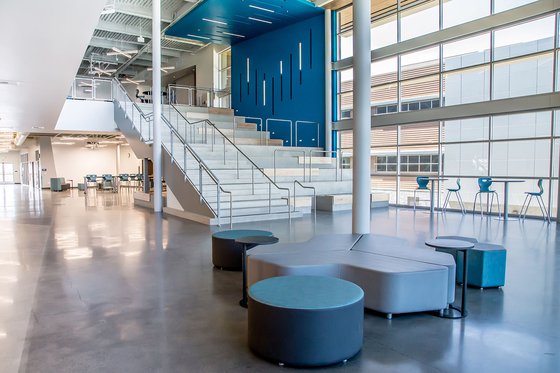
Learning stairs are ideal locations for flexible grouping, cross-curricular collaboration, and multi-grade learning. This example is from West Park High School (Roseville Joint Union HSD). (Credit: Meteor Education)

Learning stairs are ideal locations for flexible grouping, cross-curricular collaboration, and multi-grade learning experiences. (Credit: Meteor Education)