


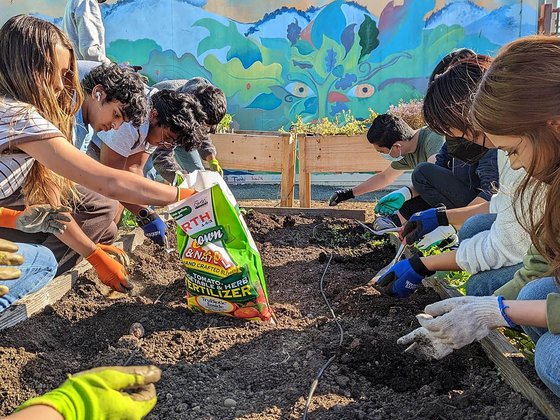
FUSD high school students planting a garden. (Photo by Nate Ivy FUSD TOSA)
Growing connection and rediscovering learning in school gardens
April 6, 2026



The following article was written by Corey Brown, director of Curriculum and Instruction, Fremont Unified School District.
This story starts with a parent peeking through a vine-covered fence at her local elementary school. She’s watching her son — and she’s crying. I’ll come back to her in a minute, but I promise this story has a happy ending.
After years of effort by public schools to close the digital divide, we’ve finally come close. Challenges remain, but the pendulum now seems to be swinging back — away from screens and devices. There’s no fighting the age of AI; we are already living in it. As technology changes how we learn and communicate, schools have a new calling: to focus more intentionally on the human traits that will matter most — critical thinking, trust, empathy, mental well-being, physical health, and curiosity about the world and one another.
What if I told you there’s a place — often neglected and tended by only a few — that already exists on many of our campuses and can nurture all of these things, without a single screen?
According to Common Sense Media, children under 2 average about one hour of screen time daily; ages 2 to 4 average just over two hours; and 5- to 8-year-olds average about three-and-a-half hours. By high school, many students spend eight to 10 hours per day on devices, including Chromebooks, tablets, phones, televisions, and gaming consoles.
Meanwhile, that mother at the fence is watching something that no app could replicate.
In my 24 years in education, I’ve come to cherish the rare, unforgettable moments when an audible “ooh” or “aah” fills the room — or, better yet, the garden. Sometimes that moment comes from uncovering a hidden truth in a story, sometimes from a spark of curiosity that changes what a student thought they knew.
I saw it once in the 1950s planetarium at the junior high where I served as principal. When the lights dimmed and the universe came into focus, wonder itself became part of the lesson. Those are the moments that connect learning to life — moments kids can’t wait to share at home, bringing their families into the experience of learning.
Gardens can do all of this too.
Across California, educators, families, and community partners are rediscovering the value of school gardens as living classrooms. Here in Fremont Unified, we’ve created a Garden Network to connect the often-isolated individuals who nurture outdoor learning spaces at their sites. Each month, the network meets at a different school garden. The gatherings are open to the public and bring together students, teachers, board members, and parents—creating shared ownership of these spaces.
Our network highlights a wide range of outdoor spaces, all with rich curricular connections across subjects:
- Victory Gardens (historical context and food security).
- Pollinator Gardens (ecosystem study and biodiversity).
- Sensory Gardens (texture, smell, and color for SEL and accessibility).
- Edible Gardens (links to cafeterias, culinary arts, and nutrition).
- Ethnobotanical Gardens (plants that connect cultures and traditions).
- Native Plant Gardens (ecological restoration and local sustainability).
- Water Conservation Gardens (science of watershed stewardship).
- Meditation or Zen Gardens (mindfulness, focus, and emotional regulation).
These spaces are powerful, hands-on environments where curiosity and connection can grow naturally — far beyond what screens can deliver.
That mom I mentioned earlier had been invited to “spy” by the school’s speech and language pathologist. Her son — nonverbal outside his family — was working in the garden with three classmates, all with social communication goals. Their work that day involved initiating and sustaining conversations, turn-taking, staying on topic, understanding nonverbal cues, and greeting others appropriately.
Her tears came with a smile. She had never seen her son engage like this — with peers, adults, or the world beyond his home. The speech teacher had just turned over a redwood round that doubled as both seat and speaking stage. It also hid a tiny and invisible world. It wasn’t the kind of awe inspired by the stars in a planetarium, but it was awe just the same.
Her son was “oohing” and “aahing.” He was pointing, laughing, asking questions, and sharing tools. He even drew an ant carrying an egg on a repurposed plexiglass COVID barrier — now a writable fence panel for garden art. He wasn’t just in a garden or just at school. He was connected — to others, to nature, and to himself.
So much opportunity and power exist in these outdoor learning spaces. They remind us that learning doesn’t just happen under fluorescent lights or behind screens — it also happens under the sun. It’s up to us to cultivate the soil, so our gardens — and “our kids” — can truly thrive.

FUSD teachers learning outdoor education techniques. (Photo by Nate Ivy FUSD TOSA)
Green Schools
Read these stories and more at content.acsa.org/tag/green-schools.
Teamwork Makes the ‘Green’ Work: Author Elisabeth Hanrieder describes her high school’s journey applying for the California Green Ribbon Schools Recognition.
Creating Sustainable, Equitable, and Healthy Learning Environments: Authors Jen Fenton and Alison Suffet Diaz share how Environmental Charter Schools is reimagining public education for low-income communities in Los Angeles County.
Climate-Resilient Schools: Leading for Health, Equity, and Sustainability: Authors Dr. Mary Ann Dewan and Dr. Dilafruz R. Williams provide a path for school administrators to implement green initiatives.