


Healing ourselves and our systems
October 5, 2026



The following article was written by Dr. Tracie Noriega, ACSA senior director of Diversity, Equity & Inclusion, & Professional Learning. It is the second in a six-part monthly series of articles on each element of the ACSA Transformative Educational Leader (ATEL) Framework. Read the first article in the series: Transformative leadership begins with self-reflection.
What we lead for and how we lead directly affect what we teach and how we teach — this pattern creates the conditions for students. Opportunity gaps still exist, and attacks on our civil rights continue. Now more than ever, transformative leadership is mandatory. Students need leaders who can create just and affirming conditions for all students to succeed. This is partly why the ACSA Transformative Educational Leader Framework was created. The ATEL Framework serves as a mirror, a lens, and, ideally, a consciousness that supports leaders as they work toward creating conditions for all students to belong and thrive.
The ATEL Framework defines transformative leadership through six elements: Critical Self-Reflection, Social Justice Activism, Cultural Humility, Community Responsive, Systems Intelligence, and Healing Centered. The ATEL Framework is not linear; it is cyclical, layered, and interconnected. Each element supports the others.
The ATEL Framework has already begun to serve as a tool for our members. Attendees at our September Equity Administrators’ Network meeting previewed the ATEL Framework, reflected on their leadership through its lens, and applied it to a leadership challenge. Michelle Elliot, HR director in San Jose Unified, commented, “I love how the framework leads to actionable steps.”
Last month in EdCal, I shared comprehensive thoughts on Critical Self-Reflection. CAAPLE Executive Director, Dr. Diann Kitamura, joined me for a webinar with several attendees. As we dove deeper into the element, we engaged in challenging mirror work and emerged with action items for ourselves.
ADVERTISEMENT

Healing Centered
In deciding which element should come next in the article and webinar lineup, Healing Centered made sense. Transformative leaders who continue to engage in Critical Self Reflection, may happen to excavate past trauma they experienced or even past harms they may have caused, especially to children. So what does it mean to be Healing Centered?
Many of us have been in spaces where we have discussed our “why.” Many of us have led professional development sessions asking folks to revisit why they chose to become an educator. In a recent Beyond Equity column, ACSA Diversity, Equity, Inclusion, and Innovative Learning Director Anthony Robinson wrote: “It is our why that keeps us connected to people and our own sense of well-being. It reminds us of our purpose when the work becomes difficult. It reconnects us to the students and communities who inspired us to enter education in the first place.”
I surface this because our why is central to our own healing as transformative leaders. Many of us believe that helping to change the world through education, through being a transformative leader, is our purpose in life.
So first and foremost, we start with ourselves. Healing begins internally for transformative leaders, who may seek healing through religious, spiritual, clinical means, or all of the above. Let’s destigmatize clinical support, while we are at it. On an episode of the Critically Conscious Classroom (CCC), Dr. Yolanda Sealey Ruiz discussed psychological studies. She shared that after a leader acknowledges the harm they may have caused, self-compassion and forgiveness are the door to not only moving forward, but also “unhinging from their biases and their racism.”
As transformative leaders do the internal work, they also know a healing-centered system is necessary for a thriving school community, where student, staff, and family wellness is foundational. Transformative leaders create support systems that encourage others to do their healing work for themselves and others. Another guest on the CCC, Dr. Shawn Ginwright shared a story about a California district’s “Pink Tuesdays.” (By the way, if this is your district, let me know!) These professional development days intentionally created spaces where educators could come together to share their lives and a meal before going out to do work together. He asked, “Can we go into schools and school districts and point to examples and efforts of activities that are trying to restore and heal something that had been broken?”
Transformative Leader Spotlight
The transformative leader who came to mind when I thought about Healing Centered is Dr. Marvin Reed. Dr. Reed is an assistant principal in his second year in the Dublin Unified School District. During a CCC episode, Dr. Reed shared a story in which he told his students he is a “doctor of making schools healthier,” ensuring schools aren’t sick by “helping schools and teachers.” When I asked Dr. Reed what Healing Centered meant to him and how it shows up in his leadership, he said:
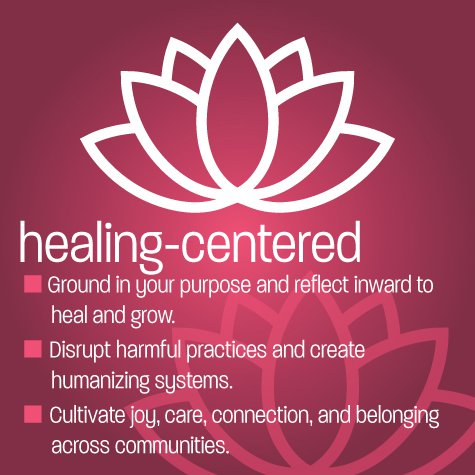
“Being healing centered means recognizing that leadership is not only about changing systems … it is also about caring for the people who experience those systems! In my leadership, this connects deeply to my Joyful Disruption framework: identifying practices that may cause harm, disrupting them with purpose, and intentionally creating something more humanizing and nurturing in their place. That means listening deeply, reflecting on my own impact, building authentic relationships, and creating spaces where students, staff, and families feel seen, valued, and a true sense of belonging. Healing Centered leadership reminds me that joy is not separate from the work of equity and transformation; joy can be part of how we heal, reconnect, and imagine what is possible together. It truly takes a village.”
Consider these critical questions:
- What healing work do I need to do to heal past traumas and lead others with greater compassion, awareness, and humanity?
- Where might our systems or practices be causing harm, and what can I do to disrupt them and replace them with more healing, humanizing practices?
- How am I creating conditions where students, staff, and families feel seen, valued, connected, and able to experience joy and belonging?
Small actions leaders can take:
- Reflect on your own healing. Journal about experiences that have shaped you, harms you may carry, and what you need to heal and thrive.
- Reconnect with your “why.” Create a regular practice that reminds you of your purpose, joy, and connection to students and community.
- Identify one practice in your school or system that may be causing harm and take a small step toward making it more humanizing and healing-centered.
- Create intentional spaces for students, staff, and families to experience connection, joy, care, and belonging.
Continue the reading journey. Here are a couple more resources to add to the list:
- “The Role of Healing in Equity Leadership.”
- “The Future of Healing: Shifting From Trauma Informed Care to Healing Centered Engagement.”
Let’s dive deeper into the element of Healing Centered. Please join Dr. Reed and me at 4 p.m. Monday, Oct. 19, for a free webinar. Attendees will work together to create a safe, brave, healing space so we can engage in critical self-reflection.
Our students need transformative leaders.
I believe that is you.
FYI
Lead. Reflect. Transform.: A Journey Through the ACSA Transformative Educational Leader Framework
What: Six-part monthly webinar series where educational leaders can deepen their understanding of each element of the ATEL Framework.
When: Next session is 4 p.m. Oct. 19 (Healing Centered)
Where: Online Learning Center
Cost: Free
Register: bit.ly/ACSA-TransformativeLeader