


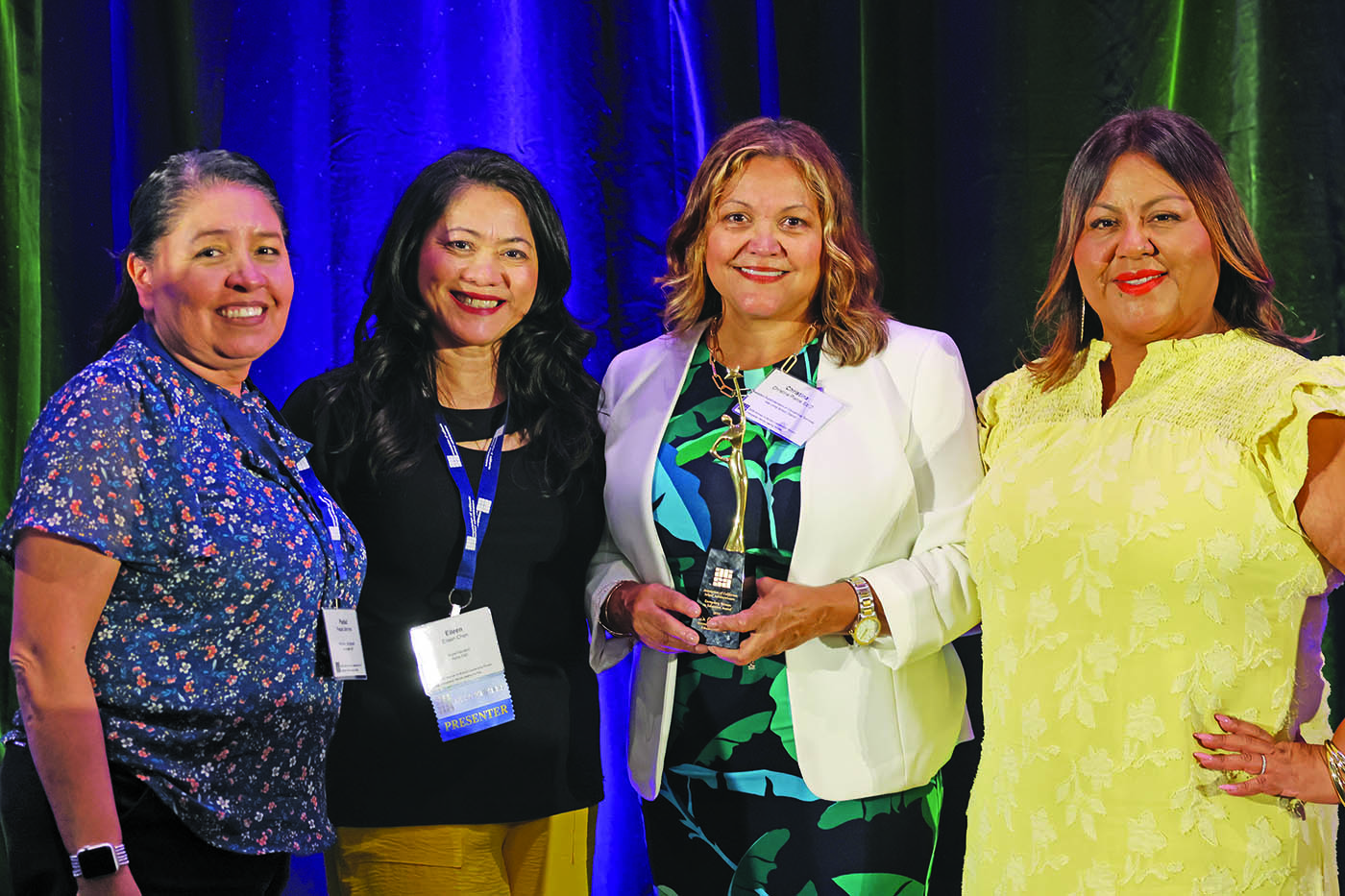
Dr. Christina Pierce (third from left) celebrates being named ACSA’s 2026 Exemplary Woman in Education with fellow education leaders during the Women in School Leadership Forum. From left, Dr. Piedad Sanchez, Eileen Aguba Chen, Pierce, and Dr. Sandra Quintanilla, who served as chair of this year’s Women in School Leadership Forum.
Pierce leads change with care and conviction
ACSA’s Exemplary Woman in Education shares her
strategies for success
October 19, 2026



With a determination to rise from her humble beginnings, Dr. Christina Pierce has overcome self-doubt and adversity on her way to becoming a leader of transformative change in her school district.
As assistant superintendent of Educational Services at Alta Loma School District, Pierce leads curriculum, instruction, assessment and professional learning, balancing high expectations with a genuine care for people that enables them to achieve at the highest levels.
Her positive leadership, commitment to student-centered decision-making, and her mentorship toward women leaders have earned her distinction as ACSA’s 2026 Exemplary Woman in Education. She accepted the award during September’s Women in School Leadership Forum.
Pierce has led the implementation of initiatives that have had a measurable impact on teaching, learning and climate. Among them, she has launched “science of reading” and math frameworks, reestablished positive behavior interventions and supports that have resulted in all 10 schools earning state recognition, and created a dual language immersion program.
Pierce is committed to serving her community as a member of the local Rotary Club, participating in winter supply drives for families in need. As a member of ACSA, she is currently serving her first term on the Council of Curriculum and Instruction Leaders, where she collaborates with educational leaders to support instructional improvement.
ADVERTISEMENT

She has played a significant role in cultivating a supportive environment for women at Alta Loma School District, and has personally invested significant time and energy into mentoring women. As a result, many women in the district have grown in confidence and effectiveness, taking on greater leadership roles and responsibilities.
EdCal asked Pierce to reflect on her path to education, how she leads through change, and what makes her an “unstoppable” leader.
What drew you to a career in education?
I was originally a science major in college, but my career path changed after I volunteered at an elementary school. After spending several months in the classroom, I began to see the impact I could have on students. They were excited to see someone who looked like them and were especially interested in hearing my story about how I had made it to college after growing up with humble beginnings in a Spanish-speaking household.
That experience changed the trajectory of my life. I changed my major to education, and from that moment forward, I knew I had found my calling.
Although I loved teaching and had no aspirations beyond the classroom, one day my principal, Mrs. Ann Malone, called me into her office and told me that she saw in me a special gift for working with people and it would behoove me to sharpen my skills in leadership. She encouraged me to consider pursuing my Master’s in Educational Leadership, a path I had never imagined for myself.
Looking back, that was one of the most pivotal moments of my career. At the time, I never imagined that I had the potential to become a school leader, much less build a career in educational leadership. I will always be grateful to Mrs. Malone for seeing something in me that I had not yet seen in myself.
The theme for this year’s conference was “Unstoppable: Women Leading the Way.” What are some ways you have been “unstoppable” in your leadership?
From a young age, I had a strong drive and determination to create a better life for myself. Growing up, I often heard, “You can’t do that,” or “That won’t work.” Rather than allowing those words to discourage me, I used them as motivation.
I learned early on to view challenges not as roadblocks, but as opportunities to grow, learn, and find a way forward. Where I grew up, that mindset was essential. If you want the opportunity to build a better and more meaningful life, you have to be willing to work hard, take chances, and persevere when things become difficult.
There have been many pivotal moments throughout my journey when I have had to dig deep, find my strength, and persevere. Those moments included navigating college when I didn’t always feel like I belonged, experiencing the loss of my parents, facing the challenges of being a female high school principal, navigating the unprecedented circumstances of the pandemic as a district and county administrator, and leading at the cabinet level through declining enrollment and significant budget challenges while working to maintain effective and relevant instructional programs.
Looking back, I realize that the challenges I faced did more than test my resilience; they helped shape the person and educator I am today.
You have led a number of systemwide improvements in your district. What is your strategy for launching new efforts to improve outcomes for students?
Systemwide improvement and meaningful change are never easy, particularly when people are comfortable with the way things have always been done. My approach has always been to begin with the end in mind: What do we want for students, and why does it matter? Once we are clear about the desired outcome, I work backward to determine what it will take to get there and develop a thoughtful, realistic plan which usually takes two to three years.
I believe sustainable change requires much more than a good idea. It takes research, data, thoughtful planning, clear communication, and, most importantly, bringing the right people to the table. The people who will ultimately implement the change should have a voice in shaping it. When people understand the purpose behind the work and feel a sense of ownership in the process, they are far more likely to embrace and sustain the change.
What are your recommendations for how districts can empower women leaders?
I believe district leaders have a responsibility to intentionally recognize that potential, build confidence, and create meaningful opportunities for women to grow as leaders. Give them a seat at the table, involve them in important decisions, and encourage them to take on challenges that help them develop their leadership skills.
I also believe we need to be honest about the realities of leadership. I have always tried to be open about my own experiences as a female high school principal, district and county administrator, and now assistant superintendent. Navigating the demands of leadership, family, and personal responsibilities is real. Sharing those experiences helps other women understand that they don’t have to have everything figured out to be an effective leader.
What advice do you have for women just starting out in their administrative careers?
Before stepping into the leadership ring, be clear about your purpose and understand that serving others sometimes means making decisions that may not be popular. Choose roles, organizations, and communities that align with your values, your leadership philosophy, and who you are.
Know yourself. Recognize your strengths, but also be honest about your blind spots.
Finally, never stop growing. Continue to develop your leadership skills, remain open to learning, and always lead with gratitude. Leadership is a privilege, and when you have the opportunity to lead, use your position to make a difference and open doors for those who will come behind you.