


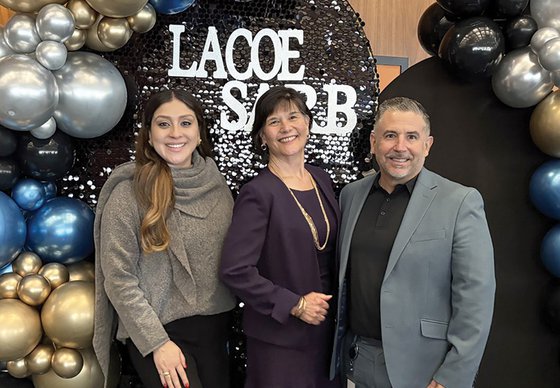
Dr. Sonya Smith, center, celebrates Lawndale ESD being designated as a Model School Attendance Review Board district. Smith has provided LEAs more support with attendance, helping to boost academic performance.
Smith expands student access to mental health support in LA County
July 27, 2026



Student Services Administrator of the Year
Dr. Sonya Smith
As ACSA’s 2026 Student Services Administrator of the Year, Dr. Sonya Smith understands the link between well-being and academic performance.
Since joining the Los Angeles County Office of Education’s Student Support Services division as director in 2021, Smith has dramatically improved students’ access to mental health services in the 80 school districts and more than 370 charter schools that she supports.
One of Smith’s most visible accomplishments has been her role in the Student Behavioral Health Incentive Program (SBHIP), a countywide effort launched in partnership with the Los Angeles County Department of Mental Health, two Medi-Cal managed care plans and 14 districts. From 2021 to 2024, the program created 160 “Wellspaces” across seven partner districts, placed 76 behavioral health interns at 51 school sites, and established 19 peer-to-peer programs.
Building on the success of SBHIP, Smith oversaw the development of the Children and Youth Behavioral Health Initiative to expand access to services to students throughout the county. Through extensive outreach, Smith and LACOE’s Mental Health and School Counseling Unit engaged nearly 200 districts and charters in this multi-million-dollar initiative.
Smith has brought the same determination to chronic absenteeism, advocating for the expansion of LACOE’s Child Welfare and Attendance team. The addition of six regional positions has given local educational agencies more support with attendance, enrollment, homelessness, and discipline-related needs. Those resources have strengthened outreach, contributed to improved graduation rates and academic performance, and helped districts exit Differentiated Assistance status.
Across her work, Smith has advocated for trainings that replace punitive approaches with other means of correction — a shift that has fostered inclusivity and reduced suspensions for the county’s most marginalized students.
An ACSA member since 2004, Smith currently serves as past-president of the ALACOSA charter and as a Region 14 President Elect. She credits ACSA’s Academies for supporting her role in pupil services and her mission to ensure every student has a stronger opportunity to succeed.
“Dr. Smith’s work is grounded in a clear commitment to building an equitable education system that meets the diverse needs of all students,” said Alicia Garoupa, chief of Wellbeing and Support Service with Los Angeles County Office of Education. “Dr. Smith is respected for her hard work, expertise and dedication to improving educational outcomes.”
What’s the best advice you’ve ever been given?
When I transitioned to the district office, my supervisor shared that my calendar is merely a suggestion, meaning that a situation involving a student in crisis or a serious disciplinary matter may arise at any given moment, and I needed to be flexible and adaptable and be ready to respond. These situations are less frequent in my current position, but this advice serves me well when we are called upon to provide crisis support for our districts and charters.
What are some life hacks that you would recommend for a new administrator?
New administrators should focus on learning about their students, families, staff and school. Learn your students’ names and something unique about them. Be visible before and after school and during recess, lunch and passing periods, whenever possible. Acknowledge your staff with thank you notes, Friday treats and kudos during meetings. And try not to take things personally. When parents come in to lodge a complaint, they want to be heard. Take a deep breath and listen intentionally.
What would people be surprised to learn about you?
People may be surprised to learn that my educational career began nearly four decades ago when I was hired as an instructional assistant. I was simply in need of a brief respite and adult interaction as I was raising a 2-year-old, but soon realized I was destined to become a teacher. After several years of working three part-time jobs sandwiched between early morning and evening community college courses, I was finally able to transfer to the university thanks to the Aide-to-Teacher Program, which covered my tuition and books for the first year. From there, I never looked back and continued taking coursework to further my career.
What’s the biggest challenge you’ve overcome in your current position?
Shifts in leadership and internal realignment are the biggest challenges I’ve overcome in my current position. During my first nine months on the job, I had three different supervisors, each with their unique personality and leadership style. With the last two, I had to create connections and build trust in addition to helping them learn about our units, teams, and staff as they were from outside of the organization. Departmental realignment brings some of the same challenges, but I am leveraging existing relationships to facilitate new ones and seeking points of connection to further collaborative conversations and coherence.
How has ACSA supported you in your career?
ACSA academies have greatly enhanced my career. I was fortunate to participate in the Pupil Services Academy during my first year on the job at the district office. In addition to learning about laws governing residency and enrollment, attendance and discipline, school safety and other topics, I met fantastic practitioners and amazing colleagues, many of whom I still communicate with. I participated in the Equity Academy during the pandemic. The online format was a bit challenging but allowed me to meet colleagues from other counties throughout California, which has proved beneficial in my current role at LACOE.
The theme for this year’s Leadership Summit is “You Belong Here: Leadership for Every Student.” What does belonging feel like for your staff?
Belonging is feeling accepted, supported, and valued. I make it a point to personally welcome new staff and provide them with a small gift. I conduct daily “relationship rounds” where I check in with staff to ask how they are doing that day. If their response seems different or odd, I lean in with an inquiry mindset to learn more about their situation and what support they might need. I participate in team and unit meetings to connect with staff and to listen to their concerns. I approach difficult conversations with “I notice and wonder” to facilitate dialogue and practice listening without judgment and collaboratively developing solutions. These actions demonstrate care and concern for my staff and help build trust and create transparency, which are critical for belonging.