


Social justice activism: From consciousness to courage
November 2, 2026



The following article was written by Dr. Tracie Noriega, ACSA senior director of Diversity, Equity & Inclusion, & Professional Learning. It is the third in a six-part monthly series of articles on each element of the ACSA Transformative Educational Leader (ATEL) Framework.
The fall season brings a change in weather, and also a new rhythm to the school year. Routines and rituals are already in place, and for those who started earlier, it may be time for that much-needed fall break. As we settle into this season, I invite you to pause and check in with yourself. How are you doing? How are you leading? And perhaps more importantly, how are you growing?
Over the past few months, educational leaders across California have joined us on the ACSA Transformative Educational Leader journey, examining their biases, interrogating their beliefs, reflecting on their lived experiences, and exploring what it means to lead with healing at the center.
The ATEL Framework serves as a mirror, a lens, and, ideally, a consciousness that supports leaders in creating conditions for all students to belong and thrive. Its six elements are not linear; they are cyclical, layered, and interconnected. Each element informs and strengthens the others.
We began our journey with critical self-reflection, challenging ourselves to look inward and examine how our identities, experiences, and beliefs shape our leadership. We then explored healing-centered leadership, recognizing that looking inward can surface uncomfortable truths, past traumas, and even harms we may have caused. Healing requires us to extend compassion to ourselves while creating conditions for others to heal, feel joy, and thrive.
Throughout this journey, one question keeps surfacing: “What do I do with what I am learning about myself?”
This question demands more than reflection. It demands action.
We are leading during a time when educational equity initiatives are constantly challenged, civil rights protections are contested, and the language of diversity, equity, and inclusion has become politicized. Yet the inequities our students and communities experience have not disappeared. Opportunity gaps persist. Systems continue to produce disparate outcomes. Students who have historically been marginalized remain most vulnerable to decisions made in the name of neutrality, compliance, or political convenience.
In moments like these, neutrality is not necessarily harmless. Silence can sustain the very inequities we claim to oppose.
This is why transformative leadership cannot stop at awareness. Critical self-reflection helps us recognize how our beliefs and biases influence our decisions. Healing-centered leadership helps us acknowledge harm and restore our capacity to lead with humanity. But neither reflection nor healing alone will dismantle the systems that continue to produce injustice.
Healing ourselves is necessary. Healing our systems requires action.
ADVERTISEMENT
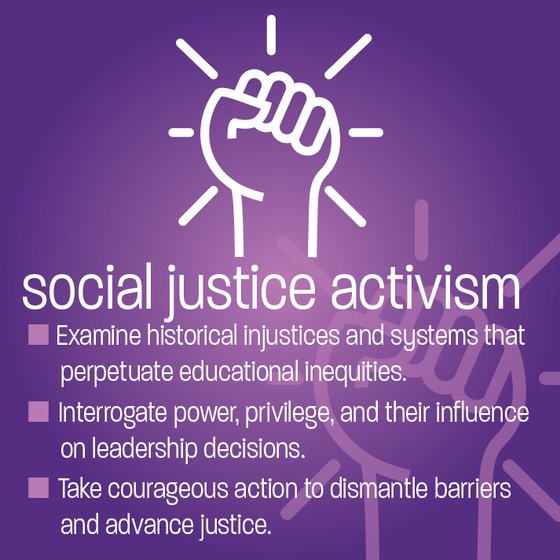
Social justice activism
This brings us to our next ATEL element: social justice activism.
Social justice activism asks us to examine not only what we believe, but what we are willing to challenge. It requires us to understand the historical foundations of inequity, interrogate power and privilege, recognize whose voices are centered or silenced, and confront the policies and practices that perpetuate injustice.
It also asks us to consider our own positionality as educational leaders. We hold influence. We make decisions about resources, opportunities, policies, and people. Whether we acknowledge it or not, our leadership can either reinforce existing inequities or help transform the conditions that sustain them.
The question, then, is not simply whether we understand injustice. It is whether we are willing to use our leadership to interrupt it.
Transformative leadership requires us to move from consciousness to courage, from reflection to action, and from individual transformation toward collective liberation. It asks us not only to recognize injustice, but to refuse to normalize it. Our students do not need leaders who simply understand inequity. They need leaders willing to act.
Transformative leaders spotlight
Former ACSA President and retired superintendent Parvin Ahmadi, who immigrated from Iran as a college student, has a solid track record of standing up for what is right. I asked her what social justice activism looks like.
“A justice activist sees clearly the interconnection between economic, political, and social injustice and White supremacy, and their impact on people, especially marginalized communities and the environment,” Ahmadi shared. “Once we have clarity around how this plays out in our schools and places of work, I believe it is incumbent upon us to challenge the status quo and take steps to dismantle long-standing practices at all times and not just when it is convenient. A purposeful examination of policies and where we allocate time and funding in our schools is a must. Removing barriers in front of students and families to access the best opportunities and ensuring full access and support must be the priority. This work is not easy, but it is the right thing to do!”
EdTrust West Executive Director Dr. Christopher Nellum gives us more to consider:
“Social justice activism, to me, is the commitment to ensure that every student has a fair opportunity to succeed, regardless of their race or ethnicity, ZIP code, or circumstances,” he said. “It means moving beyond awareness of challenges and taking action to address them. As a leader, it has shaped how I approach decisions, advocacy, and partnerships by keeping students and outcomes at the center. Whether we are working to improve literacy, strengthen educator pipelines, expand college access, or make school funding more responsive to student needs, the question is the same: Are we creating the conditions for more young people to reach their full potential? Social justice activism is ultimately about translating our values into meaningful changes that improve students’ lives.”
ACSA Executive Director, Dr. Edgar Zazueta, sums it up well:
“Social justice activism is about understanding that leadership has consequences. The decisions we make, the voices we listen to, and the issues we choose to act on all matter. Good leadership means listening, understanding the context around us, and being willing to address barriers that get in the way of opportunity and belonging. At ACSA, that means supporting educational leaders, elevating their voices, and making sure the needs of students and the communities they serve are reflected in our advocacy and leadership development. That responsibility has challenged me to keep learning, reflect honestly, and use my role and our collective influence to turn those values into tangible actions that could make a small difference.”
Consider these critical questions:
- How am I using my power, privilege, and influence to challenge inequities rather than unintentionally perpetuate them?
- Whose voices are centered or silenced in our decisions, and how does this impact opportunities for students and communities?
- What inequitable practices have I recognized but not challenged, and what is preventing me from taking action?
Small actions leaders can take:
- Examine a policy or practice. Identify one barrier to equitable access and take a step toward removing it. Use the ACSA Equity Action Tool as a scaffold.
- Interrogate your decisions. Reflect on whose voices, experiences, and needs influence how you allocate time, resources, and opportunities.
- Use your influence. Speak up when you witness inequity, challenge harmful practices, and advocate for historically marginalized students and communities.
Continue the learning journey. Here are two more resources to add to the list:
EdCal: “A love letter to educational leaders.”
The Critically Conscious Classroom: Dr. Christopher Nellum.
Let’s dive deeper into Social Justice Activism. Please join Parvin Ahmadi and me at 4 p.m. Nov. 18 for a free webinar. Attendees will work together to create a safe, brave, healing space so we can engage in critical self-reflection.
Our students need transformative leaders.
I believe that is you.
FYI
Lead. Reflect. Transform.: A Journey Through the ACSA Transformative Educational Leader Framework
What: Six-part monthly webinar series where educational leaders can deepen their understanding of each element of the ATEL Framework.
When: Next session is 4 p.m. Nov. 18 (Social Justice Activism)
Cost: Free
Register: bit.ly/ACSA-TransformativeLeader
ADVERTISEMENT