


Transformative leadership begins with self-reflection
September 7, 2026



The following article was written by Dr. Tracie Noriega, ACSA senior director of Diversity, Equity & Inclusion, & Professional Learning. It is the first in a six-part monthly series of articles on each element of the ACSA Transformative Educational Leader (ATEL) Framework.
Earlier this year, ACSA unveiled the ACSA Transformative Educational Leader (ATEL) Framework. I developed this framework to define transformative educational leadership and provide a structure for ACSA’s professional learning offerings that help to develop the crucial skills needed to meet the challenges facing schools today.
But this tool was also developed for the benefit of our members. What we lead for and how we lead directly affect what we teach and how we teach — this pattern creates the conditions for students. As opportunity gaps still exist, transformative leadership is mandatory. Students need leaders who can create just and affirming conditions for all students to succeed.
As we begin the 2026-27 school year, I invite you to join me on a journey as we explore the six elements of ATEL with articles each month in EdCal. There will also be an opportunity to participate in a live webinar, where you can join other leaders on this journey and practice the skills associated with each element.
The ATEL Framework defines transformative leadership through six elements: Critical Self-Reflection, Social Justice Activism, Cultural Humility, Community Responsive, Systems Intelligence, and Healing Centered. The ATEL framework is not linear; it is cyclical, layered, and interconnected. Each element supports the others. One element may be needed more than another, depending on the context of leadership and specific leadership challenges, but Critical Self-Reflection serves as the foundation and the through line, so that is where will begin our exploration of the ATEL Framework.
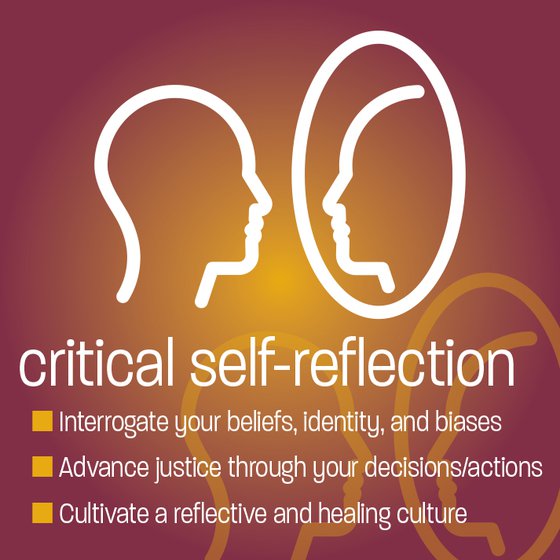
Critical Self-Reflection
Cycles of inquiry, participatory action research, lesson design — all of these processes include the aspect of reflection. These are perhaps easier done in a group setting, but any type of mirror work will be challenging. Admittedly, it is difficult to look at past actions and decisions, especially if the results were not what we wanted or expected. Yet, we also know that growth happens in those spaces by looking back and learning. Transformative Leaders more than likely lead this work, which is why they must start by looking in the mirror.
Critical self-reflection goes deeper than reflecting on an action plan or a particular process. Scholar Paolo Freire posits that critical self-reflection must include questions of how we understand race, ethnicity, gender, class, and systems of oppression. We must interrogate our belief systems and how they were formed. Dr. Gloria Ladson-Billings discusses a need for a racial identity development process in educator professional development. At the Transcendent Leader Institute of aspiring and current superintendents, Dr. Tyrone Howard led attendees through an exercise that took us back to childhood. These opportunities are not all rainbows and unicorns, but recognizing that our beliefs directly influence the decisions we make helps us understand the impact of our actions, especially the decisions we might make for communities we do not come from. Dr. Shawn Ginwright suggests shifting from a lens to a mirror, where we as leaders look inward at our own lived experiences and personal traumas to work toward individual healing. Critical self-reflection is also a gateway to a critical consciousness that ultimately requires action, like Social Justice Activism, another element in the ATEL Framework.
Critical self-reflection is not innate; it must be developed and practiced consistently over time. Transformative Leaders purposefully seek out opportunities that help them develop their practice. In turn, they create conditions for others to move closer to embodying critical self-reflection across their systems. As Transformative Leaders seek out opportunities, they also provide those opportunities for others, collaboratively creating conditions for whole systems to be grounded in critical self-reflection and growth.
“Critical self-reflection asks me to dig deeper, to understand where [my] beliefs came from, whose experiences they honor or overlook, and whether my actions truly align with my core values.”
—Dr. Diann Kitamura
Executive director of CAAPLE who will join part one of a new monthly webinar series on the ACSA Transformative Educational Leader Framework
ADVERTISEMENT

Transformative Leader Spotlight
The Transformative Leader who comes to my mind when I think of critical self-reflection is Dr. Diann Kitamura. Dr. Kitamura has served and led for over 44 years. She is the retired superintendent of Santa Rosa City Schools who led her community through multiple wildfires and the COVID-19 pandemic. Dr. Kitamura, a third-generation Japanese American, is the executive director of the California Association of Asian and Pasifika Leaders in Education. I’ve had the privilege of working with her on several projects, including the work of the California Equity Administrators Alliance. I have witnessed Diann share her unlearning and relearning processes out loud. Dr. Kitamura shared with me her thoughts on how critical self-reflection has affected her leadership.
“Self-reflection asks me to examine what I believe and how I lead,” she said. “Critical self-reflection asks me to dig deeper, to understand where those beliefs came from, whose experiences they honor or overlook, and whether my actions truly align with my core values. For me, those values are love, freedom, and authenticity. When I have the courage to hold my leadership accountable to them, justice is not simply something I advocate for; it becomes something I work to create.”
Consider these critical questions:
- What beliefs do I hold about people, learning, and power?
- What identities and lived experiences shape how I lead and make decisions?
- How am I creating conditions for others to critically self-reflect?
Small actions leaders can take:
- Journal about how you grew up and what beliefs informed your worldview. Research/consider your family history and racialized experiences.
- Create a simple end-of-the-day practice: Send yourself a voice note or journal about the day’s issues, the decisions you made, and what beliefs informed them.
- Engage in professional development or activities that explicitly practice critical self-reflection.
- Create space for critical self-reflection in the professional learning opportunities you design or lead.
Go on a reading journey. Here are a few to get you started:
- “The Four Pivots: Reimagining Justice, Reimagining Ourselves.”
- “Archaeology of Self: The Introspective Educator’s Guide to Racial Literacy.”
- “Inner Mastery, Outer Impact.”
- “My Grandmother’s Hands.”
As critical self-reflection must be practiced, please join Dr. Kitamura and me at 4 p.m. on Tuesday, Sept. 29, for a webinar. Attendees will work together to create a safe and brave space so that we can experience a critical self-reflection process.
Our students need transformative leaders.
I believe that is you.
FYI
Lead. Reflect. Transform.: A Journey Through the ACSA Transformative Educational Leader Framework
What: Six-part monthly webinar series where educational leaders can deepen their understanding of each element of the ATEL Framework.
When: Next session is 4 p.m. Sept. 29 (Critical Self-Reflection)
Where: Online Learning Center
Cost: Free
Register: bit.ly/ACSA-TransformativeLeader